Game guide · 020GAY8
An introduction to playing Kakurasu
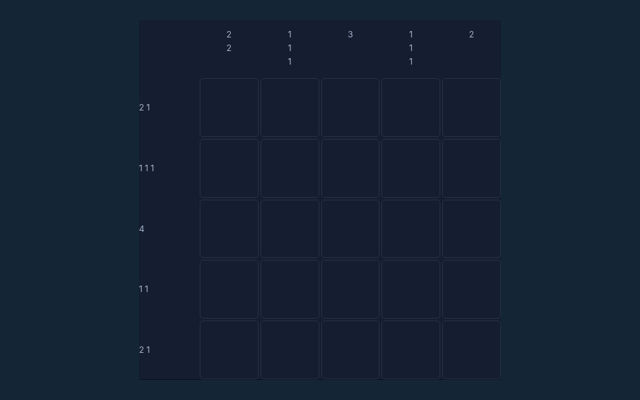
Begin with the basic rule, then follow the result of your action. Mark cells so every weighted row total and column total matches its clue. Start a new round when you are ready to try again. A 5×5 grid shows target sums at the right and bottom. Keep the goal in mind before your next move.
Generated 5×5 puzzles with an exact row-mask search for uniqueness before publication to the board. No calibrated difficulty labels.
Something to practise
Begin with the basic rule, then follow the result of your action. Tap cells to mark or clear them. Current totals are displayed alongside the target totals. Try the rule on the board, then read the next instruction.
The challenge in front of you
Mark cells so every weighted row total and column total matches its clue. Keep the goal in mind before your next move.
From the start of a round
- A 5×5 grid shows target sums at the right and bottom.
- A marked cell contributes its column number to its row sum, and its row number to its column sum.
- Tap cells to mark or clear them. Current totals are displayed alongside the target totals.
- Match all rows and columns to complete the puzzle. Each generated puzzle is checked to have one solution.
Input guidance
Tap a square to mark or clear it. Undo restores the last state. New puzzle generates another checked board. Keep the goal in mind before your next move.
See the idea in action
Read the position before choosing your next action. Marking columns 2 and 5 in the same row gives that row a total of 7. A mark in row 3 contributes 3 to its column.
Avoid this misunderstanding
The board gives you the information needed for the next action. The value is the position in the row or column, not a uniform count of marked squares. Start a new round when you are ready to try again.
Questions about this game
When I start, what is the aim of Kakurasu?
Mark cells so every weighted row total and column total matches its clue. Keep the current game state in view while applying this rule.
On this page, how do the controls work?
Tap a square to mark or clear it. Undo restores the last state. New puzzle generates another checked board. Scores here do not represent cash or prizes.
On this page, can you show an example?
Marking columns 2 and 5 in the same row gives that row a total of 7. A mark in row 3 contributes 3 to its column. The worked example offers another way to follow the rule.
On this page, which mistake should I avoid?
The value is the position in the row or column, not a uniform count of marked squares. Keep the current game state in view while applying this rule.
When I start, what rules and limits are used here?
Generated 5×5 puzzles with an exact row-mask search for uniqueness before publication to the board. No calibrated difficulty labels. Use the labelled controls for your next action.
When I start, how many people can play here?
Solo. This is local browser play, not internet matchmaking. The game is played locally in your browser.
When I start, what does a marked square contribute?
Its column number to the row total, and its row number to the column total. The instructions above use these same rules.
During a round, why can row and column contributions differ?
A square in row 2, column 5 contributes 5 to its row and 2 to its column. Use the labelled controls for your next action.
For this game, does each generated puzzle have one solution?
The generator searches the row-mask combinations and only accepts a puzzle with exactly one solution. The worked example offers another way to follow the rule.
During a round, can I clear a square?
Yes. Tap a marked square again, or use Undo. You can start a new round from the game controls.